How a visit works
The emergency department visit from arrival to going home, as patients and family see it in EDFlow: every stage, what changes at each one, and what the family view shows.
Every visit moves through the same patient-facing stages, whatever EHR the hospital uses. EDFlow works out the stage from what the care team records (an EHR event or a staff action in the console) and shows it in plain words. The stage never depends on a guess about another patient.
The journey at a glance
flowchart LR
  A[Checked in] --> B[Waiting to be seen]
  B --> C[A doctor has been assigned]
  C --> D[Seen by a doctor]
  B --> D
  D --> E[Tests under way]
  E --> F[Results back: waiting to see your care team again]
  F --> D
  F --> G[Waiting for a specialist]
  D --> H[Treatment and monitoring]
  D --> I[Getting ready to go home]
  D --> J[Staying in hospital: waiting for a bed]
  D --> K[Moving to another hospital]
  I --> L[Left the department]
  J --> L
  K --> L
Loops are normal. A doctor may order more tests after the first results, and the timeline simply adds new entries; nothing is moved or deleted. A step can also be skipped: a patient seen quickly after triage never shows "A doctor has been assigned".
The stages
These are the labels patients and family see, straight from the product:
| # | Summary |
|---|---|
1 | Checked in |
2 | Waiting to be seen |
3 | A doctor has been assigned |
4 | Seen by a doctor |
5 | Tests under way |
6 | Results back: waiting to see your care team again |
7 | Treatment and monitoring |
8 | Waiting for a specialist |
9 | Getting ready to go home |
10 | Moving to another hospital |
11 | Staying in hospital: waiting for a bed |
12 | Left the department |
What changes at each stage
| Stage | What the patient sees change | What the family sees |
|---|---|---|
| Checked in | "A nurse will check you soon", and the arrival-to-triage wait when the hospital has enough history. | Checked in |
| Waiting to be seen | The usual wait to see a doctor, a nurse practitioner or a physician assistant. Hidden for the most urgent triage levels, where the message is that the sickest people are always seen first. | Waiting to be seen, with the same estimate |
| A doctor has been assigned | The name and role of the person assigned. No estimate: they come as soon as they can. | Waiting to be seen |
| Seen by a doctor | "Your care team is working on a plan with you." The care-team card fills in. | Seen by an emergency care provider |
| Tests under way | Each test with its steps and usual wait, and how many are back. Never the results. | Care in progress (no tests) |
| Results back | "Waiting to see your care team again", with the usual time until reassessment. | Care in progress |
| Waiting for a specialist | The specialty in plain words, unless the hospital hides it. | Care in progress |
| Treatment and monitoring | How long the team would like to watch, without "longer than usual" messages. | Care in progress |
| Getting ready to go home | Wait for the nurse to go over instructions and take out the IV. The going-home summary when it is published. | Care in progress, or "Getting ready to go home" only when the patient turns it on |
| Staying in hospital | Waiting for a bed upstairs, then "Your bed is ready". | Staying in hospital (no unit or bed) |
| Moving to another hospital | The team will say when and how. | Moving for more care (no destination) |
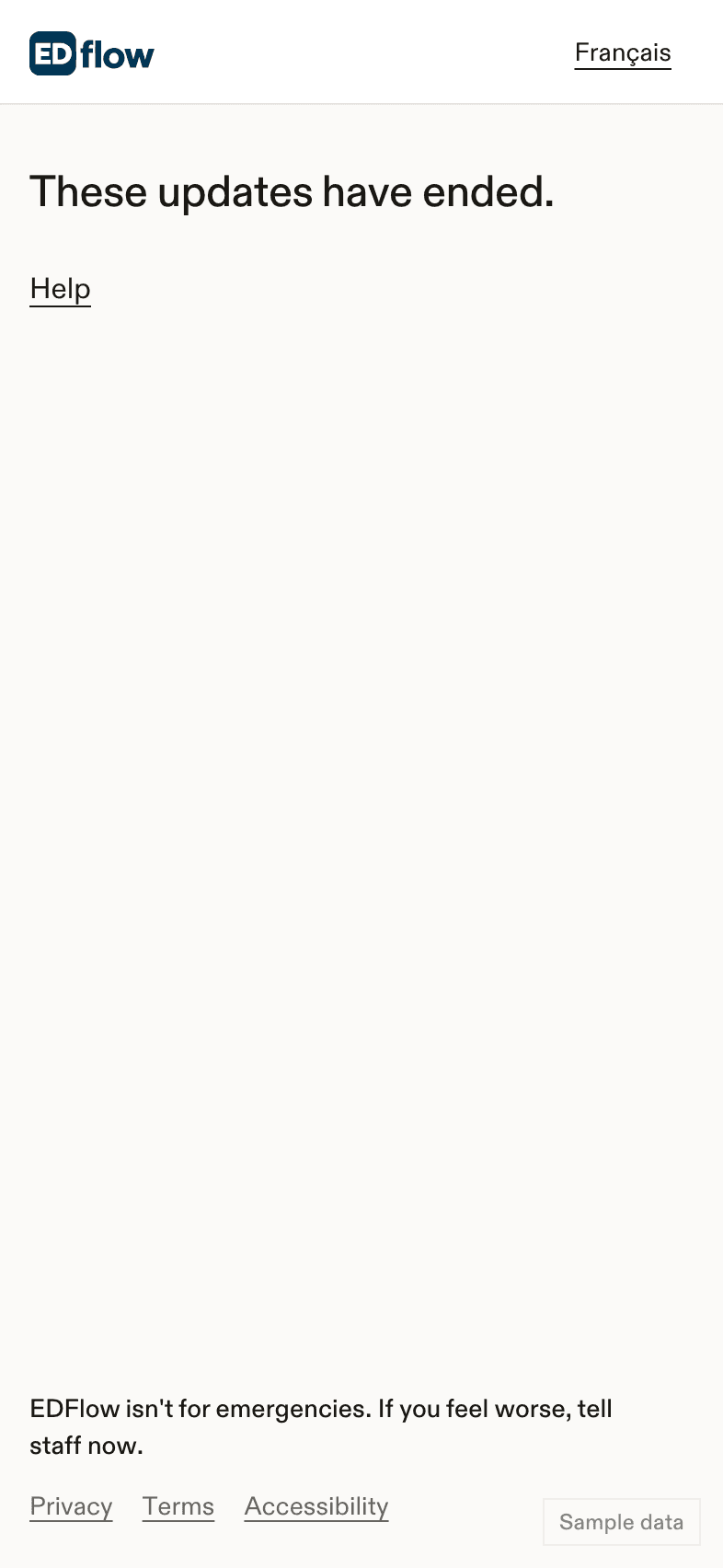
| Left the department | A read-only view with the summary and feedback for a limited time. | A short departure message, then the updates end |
Where each fact comes from
- Arrival, triage, the doctor assignment and "seen" come from the EHR feed, or from the charge nurse or clerk in the console when there is no feed.
- Tests come from orders and their status in the EHR. Some hospitals delay "results are back" by a few minutes so a clinician sees them first.
- Codes and volume come from staff in the console.
Patients see the same timeline whether a fact came from the EHR or from a staff member. Staff see where each fact came from.
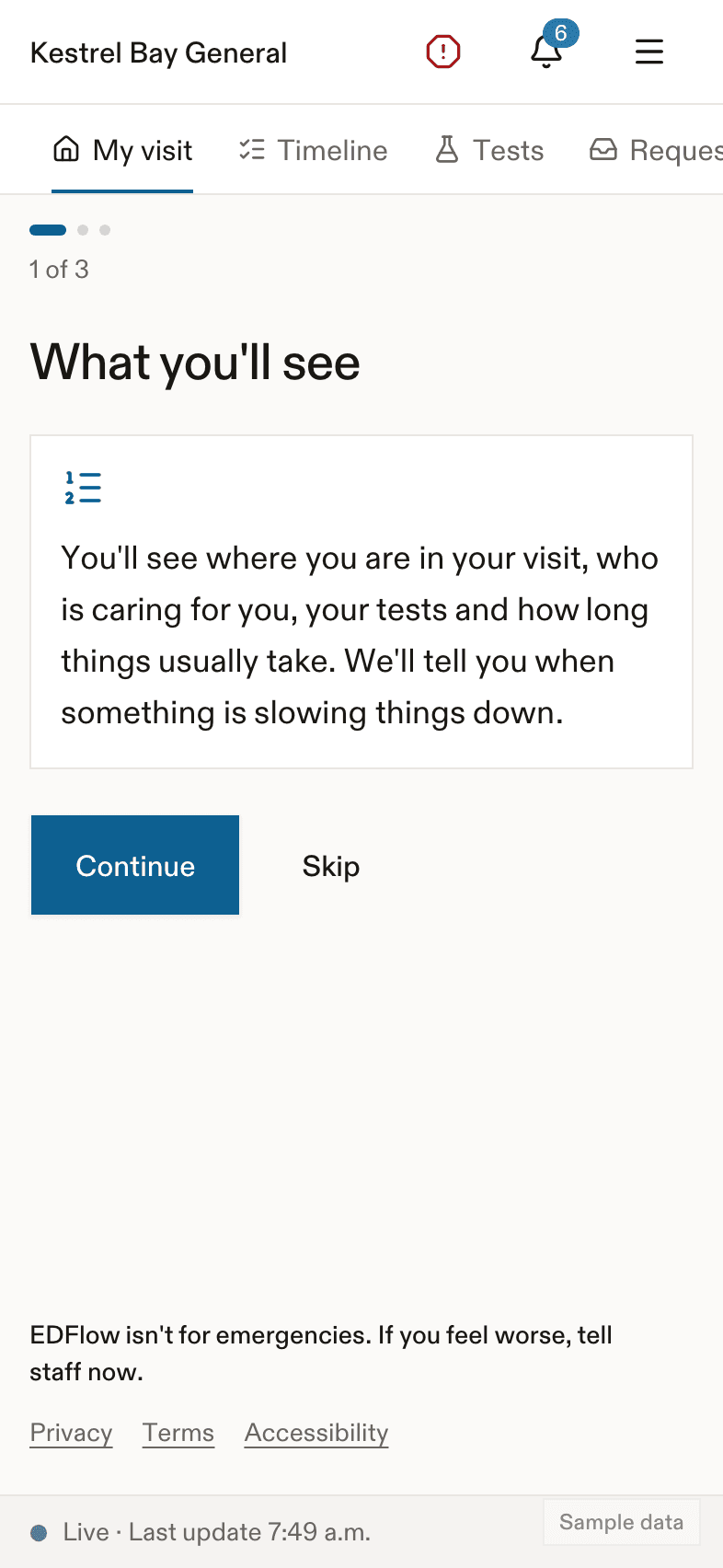
How family see the visit
The family view shows much less: the stage in family words, the estimate only while the patient waits to be seen (or for a bed, when the hospital allows it), the first names and roles of the doctor and nurse, and hospital information. It never shows tests, results, requests, where the patient is in the department, or anything the patient wrote.
Related
- Your visit, Timeline and Tests for patients
- What family can see for family members
- What patients see for staff answering questions at the bedside
- Why wait estimates should under-promise on the product site
Last updated on